
Heather Stirratt was confirmed as the new GLOS Board of Directors Chair, in October 2025. Heather has served on the GLOS board since November 2023, and brings more than 25 years of experience in coastal and fisheries management, including leadership roles with NOAA and the International Joint Commission, to the role of Chair. We are looking forward to learning from her thoughtful leadership. Her deep connection with the Great Lakes community will guide GLOS as we continue charting new waters and advancing shared goals for stewardship and innovation.
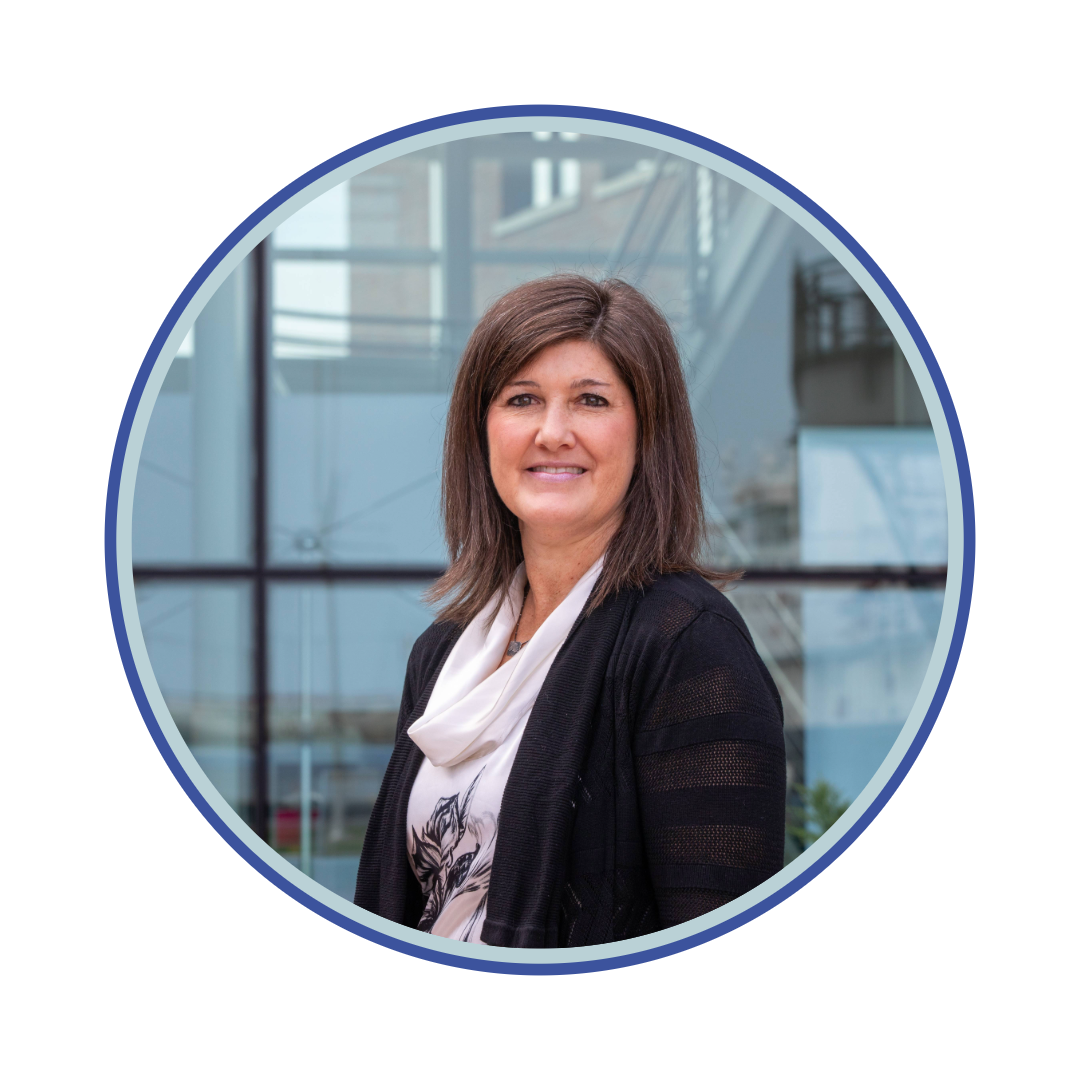
Heather shared her thoughts on GLOS and becoming Chair:
It is truly an honor serving as the incoming Chair of the Great Lakes Observing System. GLOS is a regional asset—delivering high-value, real-time data that informs time-sensitive decisions and drives economic resilience. Whether it’s helping a recreational beach user avoid dangerous water conditions or guiding infrastructure investments in shoreline communities, GLOS turns observation into action.
The organization’s impact is tangible. It supports commerce and navigation, enhances public safety, and strengthens severe weather readiness. GLOS data helps reduce costly economic disruptions, protect lives, and optimizes resource allocation across sectors. It’s a smart investment with regional, national, and transnational returns – which makes GLOS unique.
Looking ahead, I envision GLOS as a leader in applied environmental intelligence—leveraging modernized technologies to deliver faster, more accurate insights. We’ll continue to expand our observing network, refine our tools, and ensure that Great Lakes stakeholders—from local governments to public users—have the data they need to act with confidence.
In light of the organization celebrating 20 Years of GLOS, this was also a great opportunity to speak to Heather about the importance and impact of the organization, and what she envisions for its short term and long term future.

Here is that conversation between Board Chair Heather Stirratt and GLOS Communications Specialist Sam Johnson:
Sam: Exactly how many years have you worked with or been directly involved with GLOS?
Heather:
“This makes me feel a little dated, but I’ll share that I remember a time when I was working at NOAA’s National Ocean Service (NOS) for the Assistant Administrator, and he was tasked with overseeing and working closely with each of the NOS program offices.
When I first started that job, coastal and ocean observing was not a (big “P”) program office within NOS. NOAA’s Coastal Services Center helped to get IOOS off the ground, and once [its] mission started to catch fire, there was a lot more discussion around building out regional associations across the United States. It quickly became something that partners and constituents alike really embraced and as a result it became its own program office.
I remember when official budgets were first appropriated for the IOOS program office. There was a new office director and technical staff hired, and then very quickly after that the regional associations first came into being. It wasn’t all that long afterwards that GLOS, version 1.0, was founded.
I started working with the regional association [through] work that NOAA was doing in the lakes, and, because it started within the office that I eventually started working for, I worked very closely with GLOS. The partnerships and projects that were being conducted were highly complementary to the work that I was supporting with the state coastal management programs.
It’s been a long evolution, from those early days. Budgets have expanded, programs have broadened, the observing infrastructure deployed has greatly increased, as has the number of partners that GLOS is working with. It’s been great to see, both the success of IOOS as a program and, so too, GLOS as the regional footprint of that program. The Great Lakes region has taken a firm interest in and continues to invest in and partner with GLOS.”
Sam: In the formation of IOOS and designation of regions, was there ever a question about how the Great Lakes would fit in the ocean observing system?
Heather:
“When I took the job coming from DC, the National Ocean Service was underrepresented in the Great Lakes – we didn’t have a lot of staff that were deployed in the region. So it was a challenge at the time to make sure that each of the program offices within the [National] Ocean Service had representatives here in the region who could actually develop trusted relationships with partners, better understand user needs, and move those programs out in a way that would allow them to better address the needs that were expressed.
When GLOS and all IOOS regional associations first got started, there wasn’t a centralized Data Management and Cyberinfrastructure (DMAC). There was a program implementation plan, but it hadn’t been fully implemented. So there were things that we were just trying to get off the ground and it took some time for sure.
I think that is the beauty of these programs: you learn and you evolve and change over time. You have to be open to change and modify [the programs] over time, because technologies change and user needs vary. It really does require you to be resilient.”
Sam: Are there any particular GLOS moments or pivotal projects that stand out to you?
Heather:
“The development and deployment of Seagull was pretty unique amongst the regional associations. I do think that the Great Lakes Observing System is a leader in many regards, and there are many things that we have explored and tried that have been well adapted and are transferable to other regions.
Seagull is a great example of one way that we have delivered data and real-time information out to folks in a useful format. It’s also been a good way to bring people and new partners to the table. The Nested Seagulls, for example, and some of the work that we’ve been doing with our indigenous partners here in the region is really exciting work. Working with communities and with small businesses that really need information is exciting. I love seeing examples of Seagull where communities have really bought into it and they are supporting it and they’re using that information for a variety of purposes. It speaks volumes about the utility of [Seagull] and what it means at local scales.
I think the more information that we can supply folks with, the better situated and positioned they will be to make informed decisions that keep their clientele, their communities, their beachgoers, and their recreational groups safe.
Sam: Where do you see the organization going from here?
Heather:
“GLOS has really developed over time and I’m looking forward to seeing that continue in the next few years. I think we’re at this really interesting intersection of wanting to make sure that we’re always cost-minded and working towards efficiencies gained, always, and simultaneously doing a better job of meeting people where they’re at and addressing user needs.
I do think we can do a better job of partnering with our Canadian colleagues, because we operate uniquely within a shared water system. I am very mindful of the fact that our region is coming out of what has been a remediation and restoration minded period of time where we’ve been focused on the removal of the areas of concern and making sure that our water quality is preserved for future generations. Now there’s an opportunity for us to really turn the page to what could be an economic transformation for our region. We want to make sure that the economy is moving forward and that we’re building a resilient economy and simultaneously doing a good job of stewarding our freshwater resources. The only way you can know if you’re doing that is by actively observing the environment that you’re operating in.
So I see a real strong role for GLOS: to both broaden its partnerships and to do a better job of addressing new and emerging needs that are on the horizon.
I think now would be a great time for us to start digging a bit deeper with non-traditional GLOS partners, especially as we start to consider early warning systems and four season observation systems that really need attention. Those are going to require a broad array of new and innovative partners.”
Sam: What projects/programs are you most excited to dig into as Chair?
Heather:
“I am really excited about this ‘Innovation Renaissance’ around AI and what capabilities we can start to explore with machine learning. Perhaps we could make marked improvements in our forecasting capabilities and thereby reduce the risks with severe weather events. But it’s going to take time and dedicated funding to make that hope a reality. As such, I’m looking forward to diversifying GLOS’ budget and means for addressing these and other needs as users document those needs. I think this is a really exciting time where we’re going to try “new” things.
Beach safety is an area that I think is going to have a lot of [AI] applications, and I think there’s a lot to be learned on the mapping front. Of course, with that comes satellite-based imagery and other things that we might be able to better leverage going forward.
I’ve always been a big proponent of bathymetric mapping. I think the applications of mapping and the data that comes with those types of efforts can be applied for multiple uses. The fact is that many of our bathymetric maps for the Great Lakes are significantly outdated and many areas have never been mapped to modern standards – we don’t see that type of a gap anywhere else. Maybe in the Arctic, but even that’s being solved right now. So I think more attention on mapping is absolutely warranted in the Great Lakes, especially when you overlay both the lack of maps to modern-standardized requirements and shipping and commerce maps here in the Great Lakes region. It’s absolutely a national security [issue], especially when we start to think about the importance of this water system to supply fresh drinking water for millions of transnational citizens. Mapping helps us to define what’s likely to happen in the event of a whole variety of incidents in this highly dynamic and exceptionally fragile system. We must have baseline and modernized information to inform what’s truly at risk.
I guess the third area that I’m excited about is GLOS continually evolving to meet user needs. Because we are service-oriented and a large percentage of our budget comes from federally appropriated funding, we want to make sure that we’re always being relevant to the public that we serve.
I love to see GLOS sharpening its tools and expanding its reach. I know that I’ve seen that even in the short time I’ve been on the board. But I’m really excited about where we can go over the next 5 to 10 years.
Sam: Any parting thoughts for Tom Rayburn and Pete Giencke and introductory guidance for the Board and GLOS as a whole?
Heather:
“I would like to thank both Tom and Pete. Stepping into Tom’s shoes is a big role. Tom served for over 9 years; that’s multiple administrations with different priorities. He has bridged a change of directors and [overseen] an expansion of the GLOS team and the staff. There have been a lot of new partnerships that were developed based upon Tom’s leadership, having come from the shipping and commerce background. I think Adam [Tindall-Schlicht] will very nicely segue into helping make sure that that continues to be an area of further development and emphasis.
Likewise, Pete has just done an amazing job, [going] all the way back to when he was working with the [Great Lakes Commission] and keeping GLOS at the forefront of the technology developments. I think that’s always going to be a challenge for any group: trying to make sure that we’re staying on top of how best to get information out to users. Those are all things that we’re going to continue to need guidance and expert advice to navigate into the future. So, yeah, big shoes to fill.
I am ever grateful for everything that they have done to date and we’ll be looking for ways to continue to move their ideals and “legacy for good” forward for many years to come.”
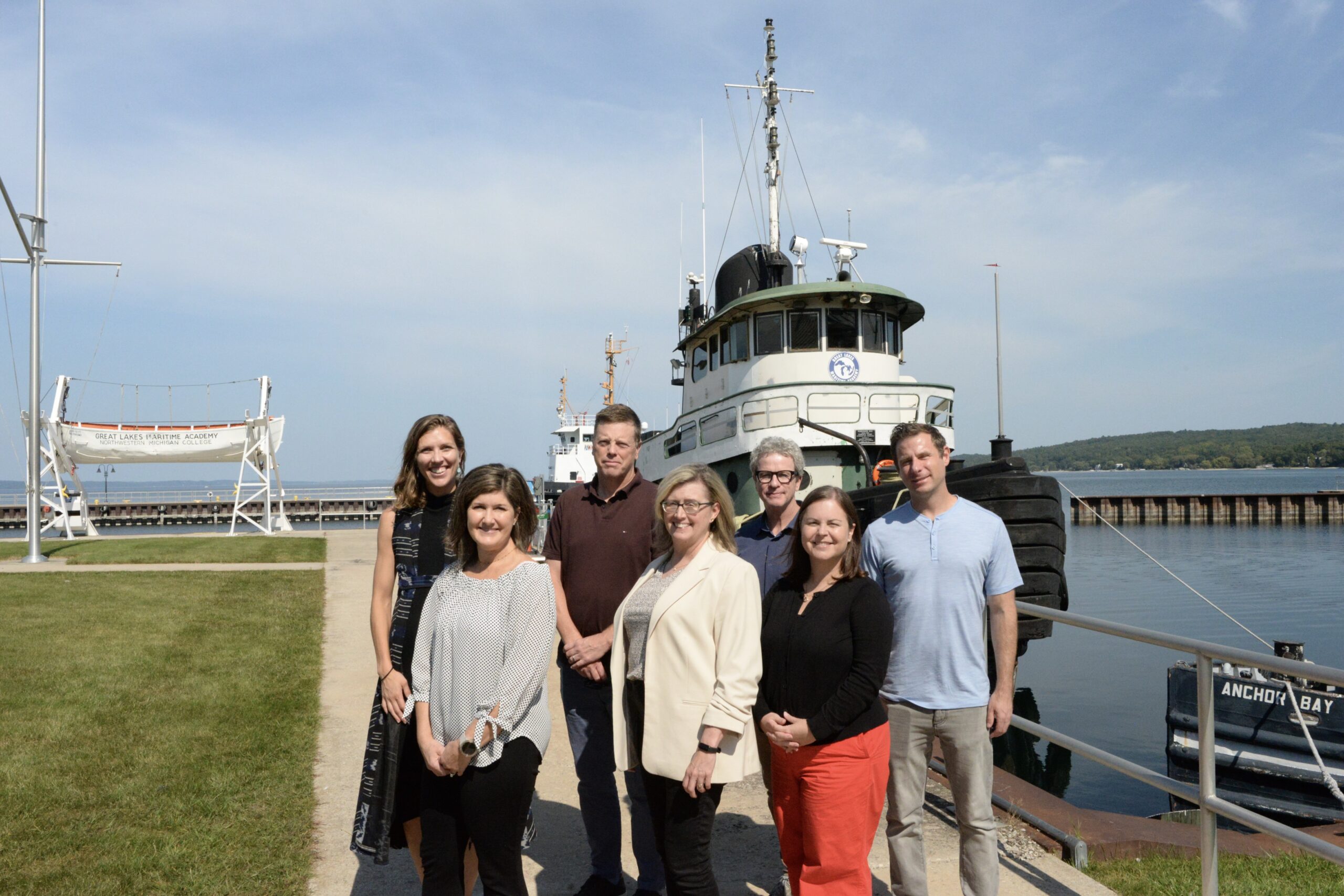
GLOS Staff and Board at 2025 IOOS Fall Meeting in Traverse City, MI. Sam Johnson
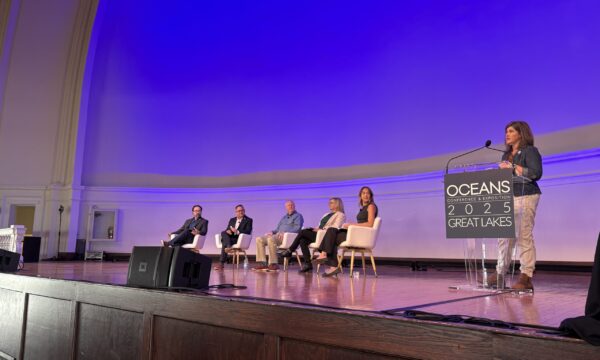
Heather Stirratt (right) moderating the Lakebed 2030 Town Hall at the Oceans 2025 Conference in Chicago, IL. Sam Johnson

Heather Stirratt (center) on the Keynote Panel at the 2024 Lakebed 2030 Conference in Traverse City, MI. Jacqueline Southby