
Tom Rayburn has reached the end of his term with the GLOS Board of Directors. From his early involvement in GLOS’ inception to his years as Board Chair, Tom Rayburn has been a driving force for collaboration in the Great Lakes community. He has helped strengthen partnerships, advance technology, and expand the organization’s role as a binational data system supporting science, policy, and industry.
Before Tom sailed off into his next adventure, GLOS Communications Specialist Sam Johnson had the opportunity to meet with him and ask him some parting questions. Since Tom has been involved with GLOS for much of the organization’s existence, this also allowed for a retrospective while we celebrate 20 Years of GLOS.

Sam: Exactly how many years have you been involved with GLOS? And how have you supported the organization in that time?
Tom:
“I started when I was with the Great Lakes Commission, in 2004. With the initial [Request for Proposals], we set up the basis for GLOS and started with a series of internal and external meetings asking ‘what does it [GLOS] really mean?’: What are we looking for? What data are we going to serve and what audiences are we going to serve? What’s most important and what’s least important? What are we actually capable of doing now and what could this look like going forward?
So we developed a business plan. We looked at it as kind of an entrepreneurial endeavor, since it was creating a new organization and a new national network.
It was great to be at that stage of GLOS.
I ended up moving on [from GLC] in late 2004. And then in 2016, a former boss of mine from the Coast Guard, Randy Helland, called me up. He was on the [GLOS] board, and he wanted to see if I’d join. I had just started with the Lake Carriers Association in 2015, and I was working with the maritime community and the [GLOS] assets that were available, so I could see data needs from the maritime community and the boating community angle.”
Sam: When you were with the Lake Carriers Association, was GLOS a well-known and used resource?
Tom:
“Yes, the mariners used data coming from GLOS. They’ve been doing that since before Seagull. They have always found the best served data that’s available to them, because they’re on the water every day. The US fleet moves 90 million tons of product every year. It is critical for them to have accurate data. In total, 141 million tons is moved on the lakes each season, when you add in Canadian and international fleets. The combined fleet has a $35 billion economic impact between the US and Canada. A lot rides on good data and great seamanship.
[Data access] has grown in leaps and bounds. You can go back and look at Edmund Fitzgerald. People were getting their weather reports by calling other vessels, radioing the vessels that were ahead of them to find out what the weather was like, and then those ships were giving the data to the vessels behind them. It wasn’t sophisticated. Now you can get it real time from assets directly on the water and that helps those mariners make better and safer choices than they were making 50 years ago.”
Sam: What has been GLOS’ biggest accomplishment, or its stand out milestones, from your perspective?
Tom:
“The biggest one, you know the one we talk about now, is Seagull. I mean, that really revolutionized at least how people in the Great Lakes were accessing the data. Throughout the years, GLOS has added more and more assets, building up the partnerships to share that data. The National Weather Service relies on some of the data that is provided by GLOS to help make their forecasts.
Except for the Seagull platform and whatever comes next, it’s just been these incremental steps of what data can you collect, what resources do you have that can collect more data, and what are the partnerships that can either provide you more data or you can provide them. The Great Lakes is a global network. There are so many Great Lakes organizations, and the Great Lakes folks share a lot of data. [The Great Lakes region] is free-flowing with people and information and ideas. There are many core pieces of that that help push the information and data, and GLOS is probably the biggest one. So it’s great, when [the data] is free and accessible to anyone with electronic devices.”
Sam: Where do you see the organization going from here?
Tom:
AI. What can we do with those large language models that help us find the data, that helps us bring in more information and enable us to serve up that information in new ways? The fishermen want to know where the best location to catch walleye is that day or that week or this coming weekend.
A user asks, “I’m living in Toledo. Where should I go fishing with my kids next Saturday? What’s the best location or what’s going to be optimal? I want to go swimming. What are the conditions in Oregon, Ohio? Are there riptides? Is it safe?”
Can this data be served up to a city where they may not have any lifeguards on the beaches, but they need to get that information out about beach safety?
With Lakebed 2030 and Smart Great Lakes as well, it’s about serving up data in new and unique ways, and it’s continuing to build those partnerships and expanding the base of data.
There’s a lot of work out there for GLOS and a lot of innovation that the GLOS team will need to tackle. You guys are all wicked smart and are always thinking and always working. GLOS has great respect throughout the Great Lakes and nationally. And throughout Canada as well.
Sam: What is a fond memory you have from your time with GLOS?
Tom: My first one was actually in Oregon State Park outside of Toledo. We were celebrating 10 years of GLOS, or it might have been 11 years of GLOS. Either way, it was neat to see GLOS at that point, which is a long way away [from now], but a great step forward from where we were in 2004. And just seeing where we’ve come from then till now, you know.
With the federal funding right now, it’s scary.
But it’s a fun group. The GLOS team and their partners are a great group. I look at all the brainpower around these observing systems, and I’m very impressed. GLOS has that scrappy, entrepreneurial energy..
Sam: Any parting advice for the Board? Staff? The Observing System as a whole?
Tom: Have fun. If you don’t have fun, it’s not going to work. That’s kind of how I have looked at my career. It can be hard at times, but if it’s not fun, it’s not going to get done.
It’s going to take strong support from the board. Heather, Aaron, Annie, Mary-Claire, Leon, Stephanie, and the newest Board member, Adam, are a fantastic group. They’re engaged, smart, and creative. It’s a great team.
You guys are going to come up with things that I can’t even imagine right now and it’s going to happen more quickly than I can imagine.
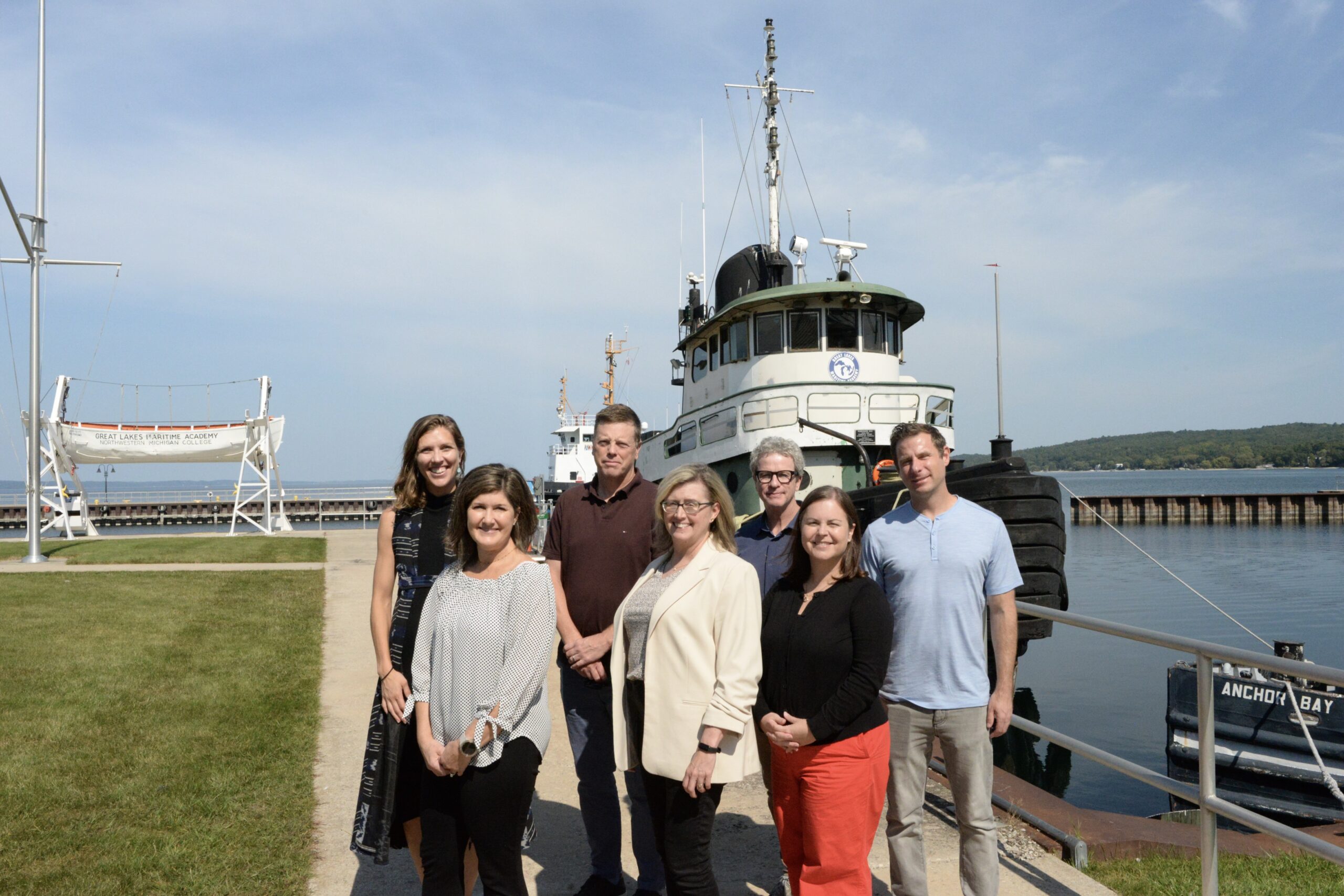
GLOS Staff and Board at the 2025 Fall IOOS Meeting in Traverse City, MI, September 17, 2025.
Thank you Tom!
We are deeply grateful for your leadership through the years and your commitment to the protection and safe enjoyment of the Great Lakes.