
We would not have the opportunity to celebrate 20 Years of GLOS, if it wasn’t for the many individuals who contributed their time and ideas to help the organization grow and flourish – critical staff like former Communications Specialist, David Fitch. David was with GLOS for five years, from 2018-2023. His impact can still be felt today, as I, Sam – current Communications Specialist, can personally attest to. David helped establish many GLOS outreach initiatives and organizational processes that we still utilize. David met with me, back in December and shared some of his memories from his time with GLOS and reflected on the importance of the organization.
“At GLOS, it felt like we were really throwing our time and weight into something that I could say is better that this exists [than not]. It is a real ‘good’ for people that I know: people in my state and in my community.”

David Fitch
Communications Specialist
GLOS (2018 – 2023)
Sam: When did you start with GLOS?
David:
“I believe it was 2018.
I came on when I [had been working as] a freelancer doing website and communications work.
I wasn’t familiar with GLOS. I knew what NOAA was, but definitely had never heard of the Great Lakes Observing System. I decided to give it a shot.
I remember coming in for the interview, and, of course, I was running late. I was running around the lawn outside, and eventually, I found my way to the front door.
I’m glad I found the door and I’m glad I made my way in all these years ago.”
Sam: What was it that you enjoyed most about the organization?
David:
“It was the idea of an all-purpose communications job and dipping my toes into a lot of different pools, to be a kind of generalist sounded really good.
The organization’s work, as I looked into it a little bit more with no context for it – no background with any sort of environmental or scientific background, sounded necessary and important, and it sounded intriguing. I like to be able to jump into a new topic and learn all I can about it. So that was kind of exciting to me.
I think it was the ability to meet so many different people who had these really niche fascinations or obsessions with some aspect of the lakes, getting to learn about their history, and getting to learn about the technology that we had at our disposal. Getting to meet the buoys, getting to see the gliders, getting to understand the data technology behind the scenes, and getting to be the translator between scientists and researchers and technologists and the general public and the people that [are] the end beneficiaries of all the data and the lake’s health. [All of] that was really attractive to me and it felt like you can jump into a lot of different jobs and do [many of those] things as a Communication Specialist.
At GLOS, it felt like we were really throwing our time and weight into something that I could say is better that this exists [than not]. It is a real ‘good’ for people that I know: people in my state and in my community.”
Sam: Did you feel like technology advanced a lot in your five years with GLOS?
David:
“I think technology definitely did advance, and our use of technology advanced: the technology that GLOS itself was funding or building, really took leaps and bounds. When I started, we were sort of more in the middleman role. We were getting this funding and we were divvying it out to our different PIs who were putting buoys in the water and doing various data management work.
We had GL Buoys, the website, and we had a few other web-based tools for people to access the data, but we weren’t as much in the driver’s seat of the technology.
The big shift during my time at GLOS was for us to become more of a service provider ourselves, while still continuing to fund some important observing assets in the water, maintenance contracts, things like that, but trying to be more in the data-provider/product-builder role more, and bring that talent and those resources into the team.”
Sam: Are there any particular moments or pivotal projects that marked your time or GLOS’ trajectory?
David:
“One moment that really sticks out in my mind is getting the high frequency radar put in in the Straits of Mackinac. It sticks out in my mind because we did a whole program there on site. We had agency representation, some industry representation, and a state representative, and a lot of people there from the community. We did an unveiling and we talked about the technology.
That felt like a mile marker, I think, because it was something GLOS had been [seeking] funding for for a long time, and there were a lot of hoops to jump through, because [that technology] is normally meant for saltwater use. There were barriers, in terms of proving that it can be useful in a freshwater context and demonstrating the need in such a high traffic region of the lakes.”
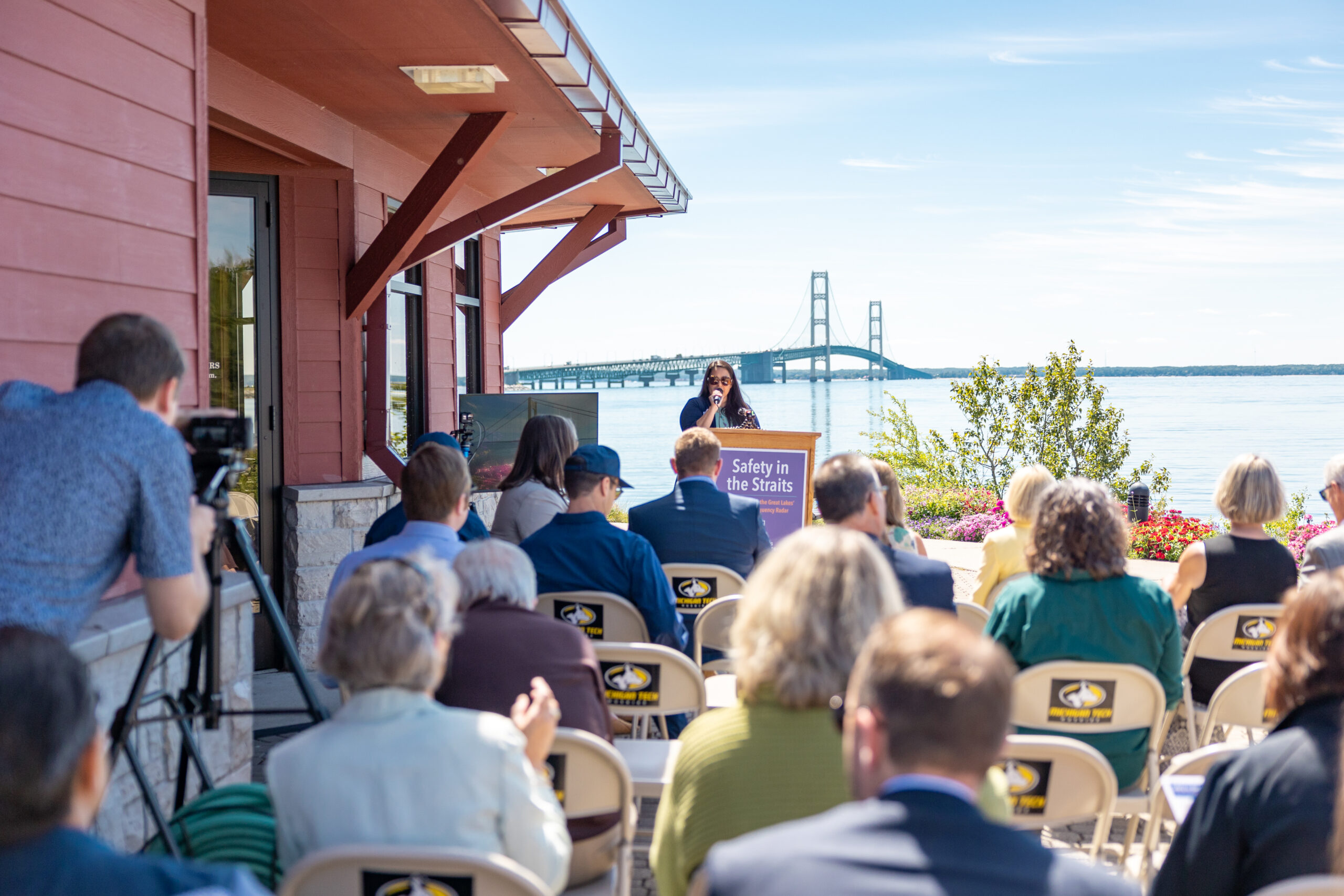
David Fitch (far left) behind the camera at the High Frequency Radar event in St. Ignace, MI, August 2022.

David Fitch (Center) at the Lakebed 2030 Conference in 2022.
Sam: How do you remember Lakebed 2030 forming and how was GLOS involved in the early stages of the initiative?
David:
“I’m not sure who to say drove it initially. There were a lot of conversations that were being had with researchers and people in the industry who were coalescing around this idea, but we were definitely a key player in summarizing what the vision of it was. [There was] piggybacking off of Seabed 2030.
Mapping, as a concept, is great, but we talked about the fact that the lakes aren’t mapped, but that we [wanted to] put a number on it and then put a date to it. Even if the date was highly aspirational. At the time it might have seemed a little more realistic. That was very helpful and I think successful, from what I understand has happened since then. But it took a while to really get the ball rolling and get momentum behind it.
It’s been theoretical for so long, or what feels like so long. I think it’s been hard for people to sink their teeth into. Harder than a buoy. A buoy is conceptually easier. It’s a thing that floats in the water, and look, we see the temperature reading from it. Whereas with mapping, it could happen a couple of dozen different ways. All the technology is growing in different ways. So what is the best way to do it? Or when? But of course the first thing that needs to come is the funding, and that’s probably gonna be the trickiest part of all of it.”
Sam: Do you have any sense of where the organization may go from here?
David:
“I think where I would see GLOS going is pretty general, and it relates to technology as a whole.
We see technology that gets built with all kinds of perverse incentives – for profit. GLOS is a nonprofit technology company. Working there made me realize it’s really important that groups like this exist. Something like Seagull, it’s not gonna be a moneymaker for some groups of shareholders, but it’s gonna be a product that needed to exist, and there needed to be some structure out there to create and maintain this thing.
I think I’m just glad that GLOS continues to exist and will continue to exist, to put more Great Lakes data in people’s hands. I don’t think there’s anybody else, no single company, that’s going to do that the way GLOS is trying to do it. There needs to be something like GLOS, for us to continue to understand the lakes and to safeguard them.
GLOS has kind of been a chameleon. It’s changed depending on the needs or the opportunities. I think the base mission hasn’t changed, but I think the way that we do it has changed, and I think it would be hard to say how an organization established in 2005 should look and exist in the science and technology world. It’s hard to say that an organization should look the same.”
Sam: Are there any other thoughts you have, reflecting on 20 Years of GLOS or your time with GLOS?
David:
“I just think back, and I’m really grateful for the people that were willing to give me a shot and willing to be patient with me and teach me. I was not, I am not, a scientific person, but there were so many people in the community who were really generous and patient with me, taught me what they knew, and connected me with people that they thought could help. I just feel really grateful that it was my first real job, with so many people that were generous and caring.”
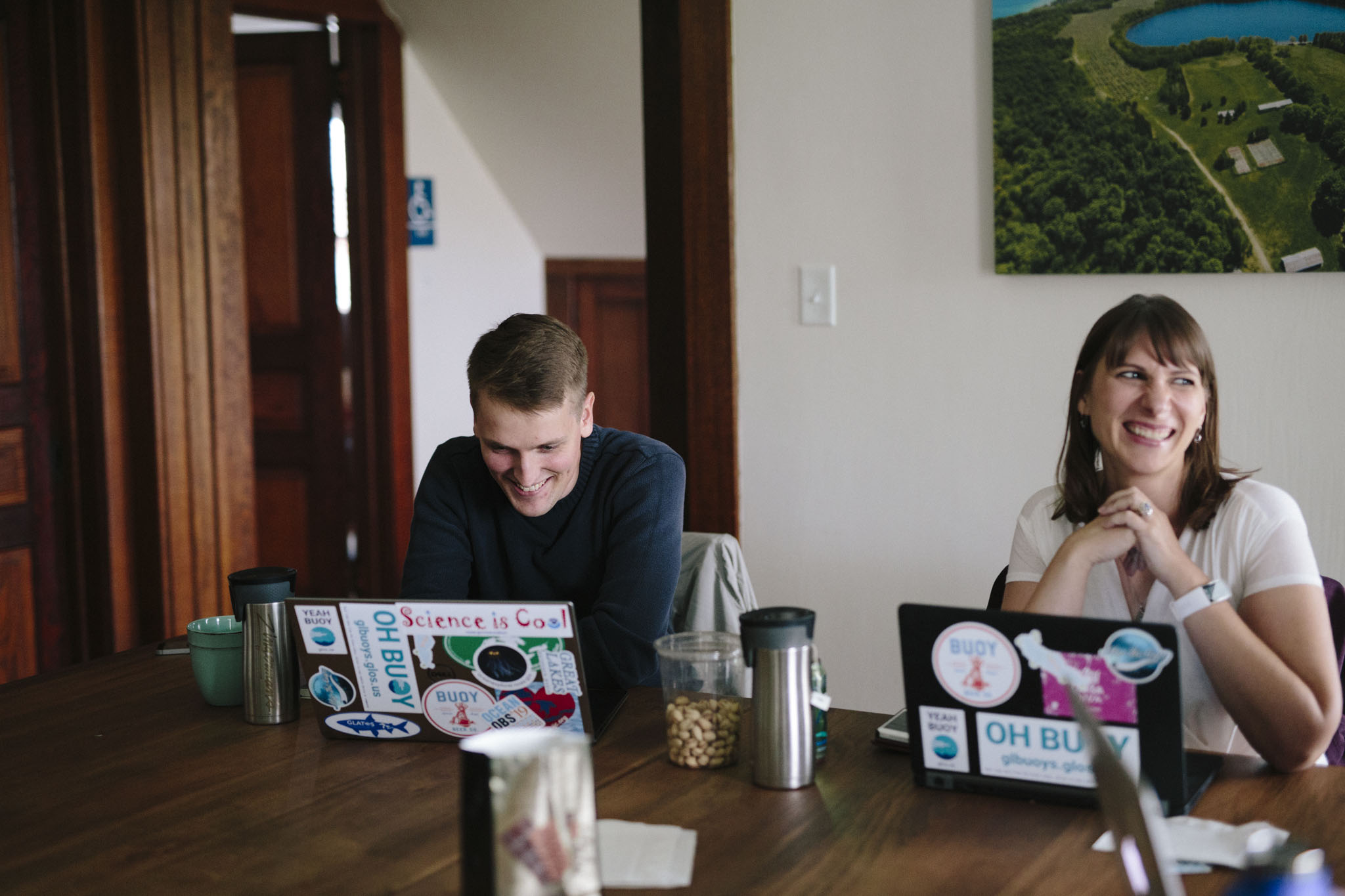
David Fitch (left) at the 2019 GLOS Staff Retreat. Also pictured: Becky Pearson (right), former GLOS Operations Office (left).
Thank you David, for all of your contributions to the organization and for sharing your thoughts and reflecting on your time with GLOS.