While reflecting on 20 Years of GLOS, we met with J. Val Klump. Val is retired from the University of Wisconsin – Milwaukee. While there, Val helped establish the School of Freshwater Sciences (the first of its kind in the country), developed one of the first observing systems, and dove the deepest depths of the Great Lakes. Having spent his career pioneering observations and research in the region, we knew Val would have invaluable insights on the past 20 years of Great Lakes observing and plenty of stories to share.
“The cost of ignorance is huge, as we know in the Great Lakes. We’ve spent billions and billions of dollars cleaning up mistakes of the past and we’re still in the process of doing that… we should get out of the restoration business and get into the preservation, protection business instead. The only way you can do that is if you can anticipate problems and avoid them in the future.
GLOS has understood that that is important. Ultimately, we want to be able to project what the future of the Great Lakes will look like, anticipate problems that might arise, and avoid them. The only way you can do that is if you have a model of the system that incorporates all the relevant dynamics that drive it. But those models are only as good as the data that goes into them.”
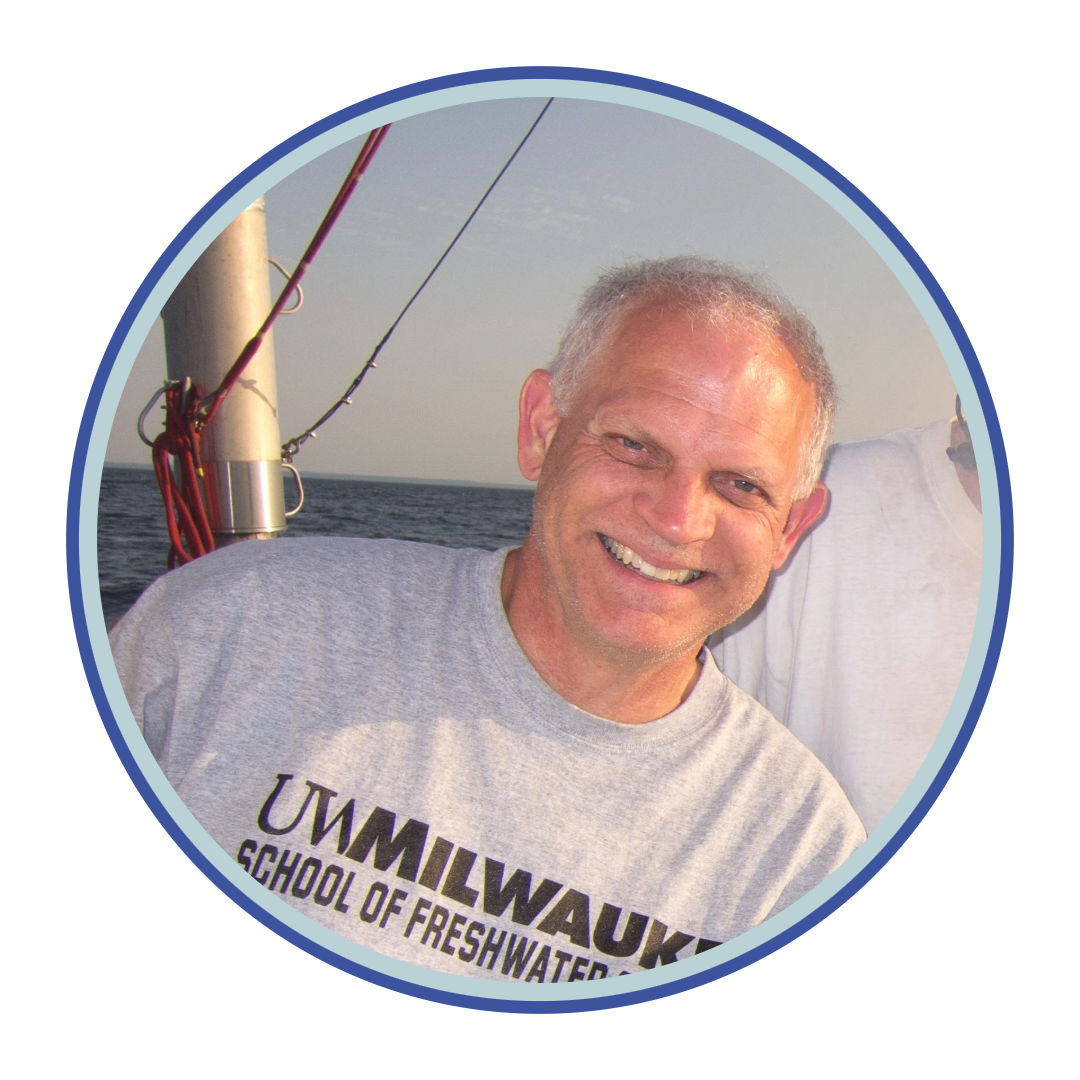
J. Val Klump
Professor & Dean Emeritus
University of Wisconsin – Milwaukee
School of Freshwater Sciences
Can you tell us about your educational background and early professional experience? How did you find yourself in this field in the Great Lakes?
J. Val Klump:
“I grew up in Michigan and Ohio, and from the age of about six to ten I had the opportunity to spend my summers on a small lake just outside Brighton, Michigan. I had a little rowboat that I could tool around in by myself. I think that was pretty informative of where I was going to be.
When I was a kid, Jacques Cousteau was in his heyday, and I was intrigued by that. So aquatic science, oceanography, was something to which I was attracted. I went to Duke as an undergrad and majored in zoology and took courses in oceanography. I was an undergraduate during the first Earth Day – that shows you how old I am – anyhow, I thought I really wanted to do something for the environment. I thought maybe being an environmental lawyer would be a useful endeavour. So, I actually went to law school at Georgetown in DC, which was interesting. I was able to clerk for an attorney at the EPA, which was a good experience. The EPA was a new agency at that time.
In your second year (of law school) you can take things like environmental law, which I did, but I decided [in that time] that I would go back to science, but, having invested a year and a half to two years in law school, I’d be damned if I wasn’t going to finish this. So that’s what I did. I finished, passed the Bar in Michigan, and then applied to graduate school and went to University of North Carolina – Chapel Hill. For my PhD, I worked with Chris Martens. I was very lucky to have him as an advisor and we are still very good friends.
When it came time to look for a job, I would have taken a job anywhere. This job in Milwaukee came up at the Center for Great Lakes Studies. I didn’t know anything about the University of Wisconsin-Milwaukee. In those days, there was no Google, but I managed to find it on a map.
I just loved the water and that’s always where I wanted to end up.
We moved on October 1st, 1980. I was the first full-time scientist hired at the Center for Great Lakes Studies.”
Were there particular characteristics of those waters or things that drew you in that really motivated you?
J. Val Klump:
“Well, I was interested in Green Bay, Lake Michigan, because my dissertation work was in Cape Lookout Bight (North Carolina), which was this mud hole in the Outer Banks that had a sedimentation rate of about 10 centimeters per year. I was interested in sediment water exchange mechanisms. So when I got to Milwaukee, I said, “I should find another mud hole to study!”
My first trip on the Neeskay was maybe in ‘81. Green Bay was interesting primarily for studying benthic processes, because sedimentation rates and organic carbon concentrations are really high – up to 10%. The rates of reaction are quick and so relatively easy to study. It’s not like an oligotrophic environment where just measuring simple concentrations is difficult. It was an easier place to study those processes.
But at the same time, Green Bay was a poster child for practically every ill experienced in the Great Lakes. It was actually the site of the first Remedial Action Plan for the Great Lakes as part of the whole development of Areas of Concern by the IJC and the EPA, back in the 80s. I served on the Remedial Action Plan Science and Technical Advisory Committee for many years. PCBs, hypereutrophic conditions, the loss of wetlands, armored shorelines, invasive species, industrial pollution, excessive runoff, climate change… Green Bay suffered it all.
It’s an interesting place scientifically, and [it’s] important economically. The fishery is hugely important – estimated as something like $260M a year economic impact – as much as the Packers! The surface area of the bay is about 7% of the total Lake Michigan basin but the nutrient load from the Green Bay watershed represents about one third of the total load to the entire Lake Michigan ecosystem.
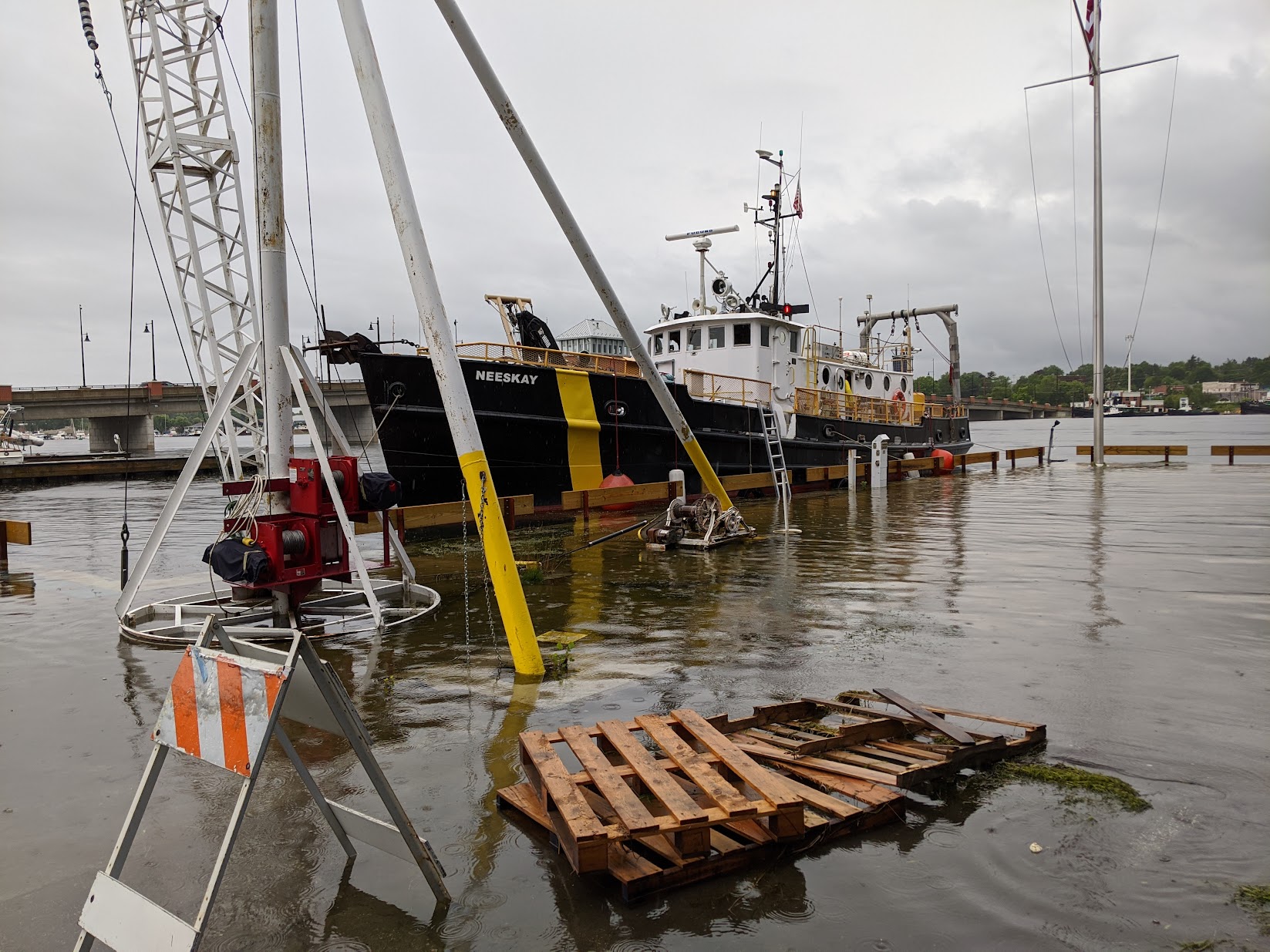
The Neeskay docked at Sturgeon Bay in high water level conditions in July 2020. Courtesy of J. Val Klump
A lot has been invested to clean the system up and there’s been a huge amount of improvement. It dates back to the passage of the Clean Water Act in 1972. Monitoring began in earnest with work of the Green Bay Metropolitan Sewerage District, now NEW Water, in the 1980s. More recently, GLOS has had a huge influence on our understanding of what’s going on – it’s the best long-term dataset we have for certain parameters and certainly vertical structure. The sewerage district has done a lot, but until just recently, they were really confined to the lower end of the bay. They didn’t do anything much north of Longtail Point. They have recently expanded their monitoring. The data from these buoys was a key part of calibrating models which is why monitoring and collecting the data is important. Otherwise we are flying blind.
I think the future of monitoring and the role GLOS can play looks, not only pretty cool, but also essential. For instance, the whole issue with invasive species that we dealt with for a long time – eDNA monitoring would be a relatively easy way to see what’s there and if something is different. We can learn a lot about the biological dynamics that we don’t know. We’ve done a good job on the physics and, to a certain extent, on the chemistry. Biology is always the hardest and this technology is going to allow us to understand a lot about the biology without having to actually go out there with a hook and line – although there will always be a need for in situ sampling – and very often monitoring helps guide with respect to when and where. Embedding the higher trophic levels into these models and better understanding how the whole system works and just having better coverage. Every time we have looked at the environment at higher resolutions in time and space, we have learned something fundamentally new. GLOS has made a huge dent in this coverage, but the Great Lakes are extremely large, inland seas really, so our coverage is still pretty sparse.”
What do you think are the major challenges for the next 20 years?
J. Val Klump:
“Every step of the way you have to convince people it’s the right thing to do. We’ve never failed to do that. Everybody you talk to says, “Oh yeah, this makes sense. This is something we should do. It’s overdue.” The cost of ignorance is huge, as we know in the Great Lakes. We’ve spent billions and billions of dollars cleaning up and we’re still in the process of that. So we still have a ways to go, and then we should get out of the restoration business and get into the preservation, protection business instead. The only way you can do that is if you can anticipate problems and avoid them in the future.
And the only way to do that is with science. Every decision – whether to build a dam or take out a dam, stock fish or set a catch quota, control agricultural runoff… you name it – all of those policy decisions ultimately boil down to science. You can’t make sound policies unless you have the science to back it up and understand what’s going on in the system.
Not everyone is going to want to know the thermal structure of Lake Superior, for example, or get excited about it, but ten years from now when you come back and you want to understand what’s been going on, that data is invaluable. A lot of times you don’t even know when you’re collecting it today how important it’s going to be in the future.”
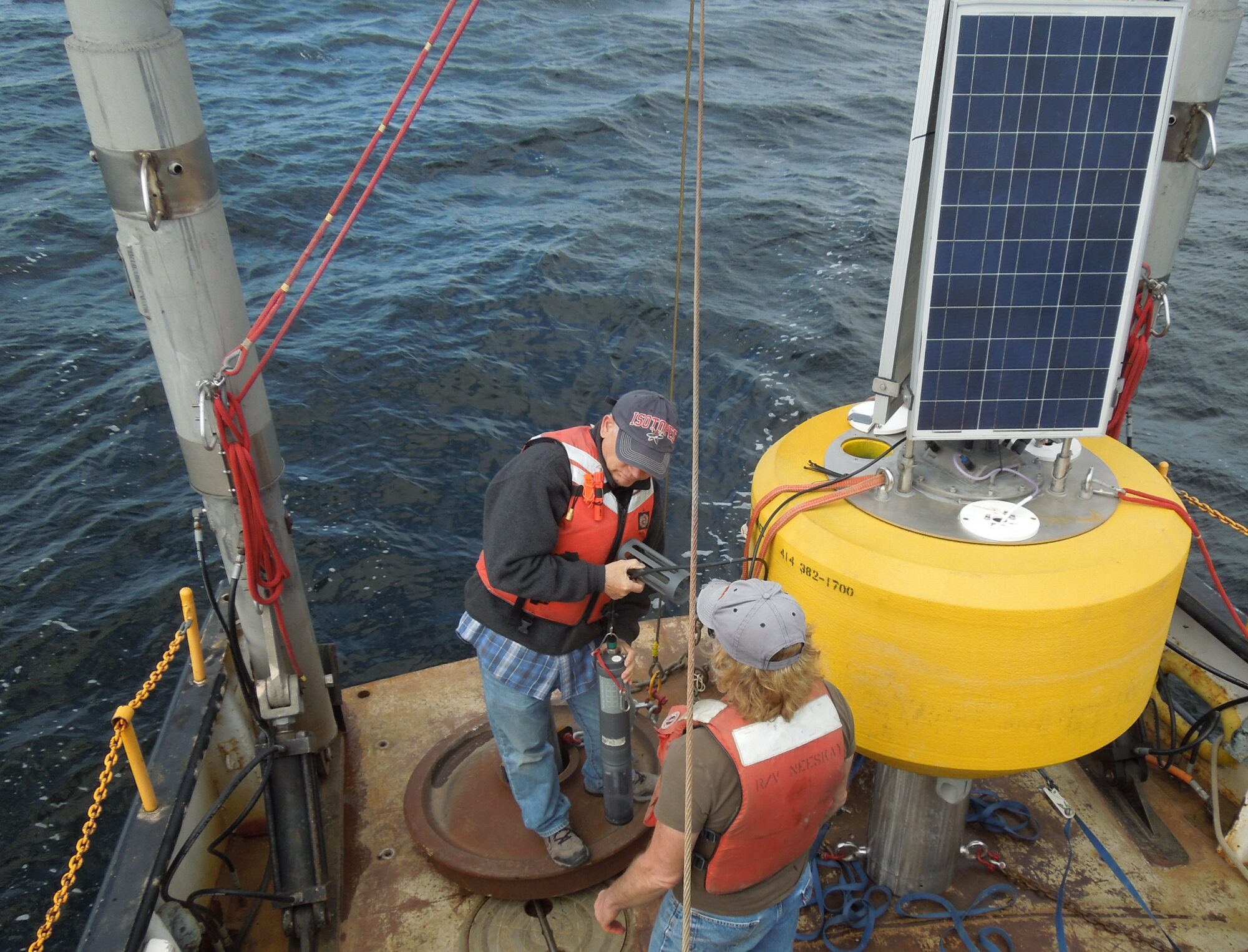
Prepping the Green Bay Buoy for deployment. Courtesy of J. Val Klump
You were one of the original GLOS PIs managing buoys. How did you first get interested and involved in real-time observing?
J. Val Klump:
“Going back to 2001, in May or June, the University decided to go after some federal funding and the only available funding was through the Department of Defense. So, I put together a two-page blurb on water security and the issues of water contamination. Within two months, they funded our proposal through the Defense Advanced Research Projects Agency, DARPA. Because of 9/11, terrorism was suddenly top-of-mind. I gave our spiel about the Great Lakes and [talked about] the size and the complexity and the fact that 40 million people drink the water out of the lakes. That impressed them and they funded us for $800,000 per year for four years.
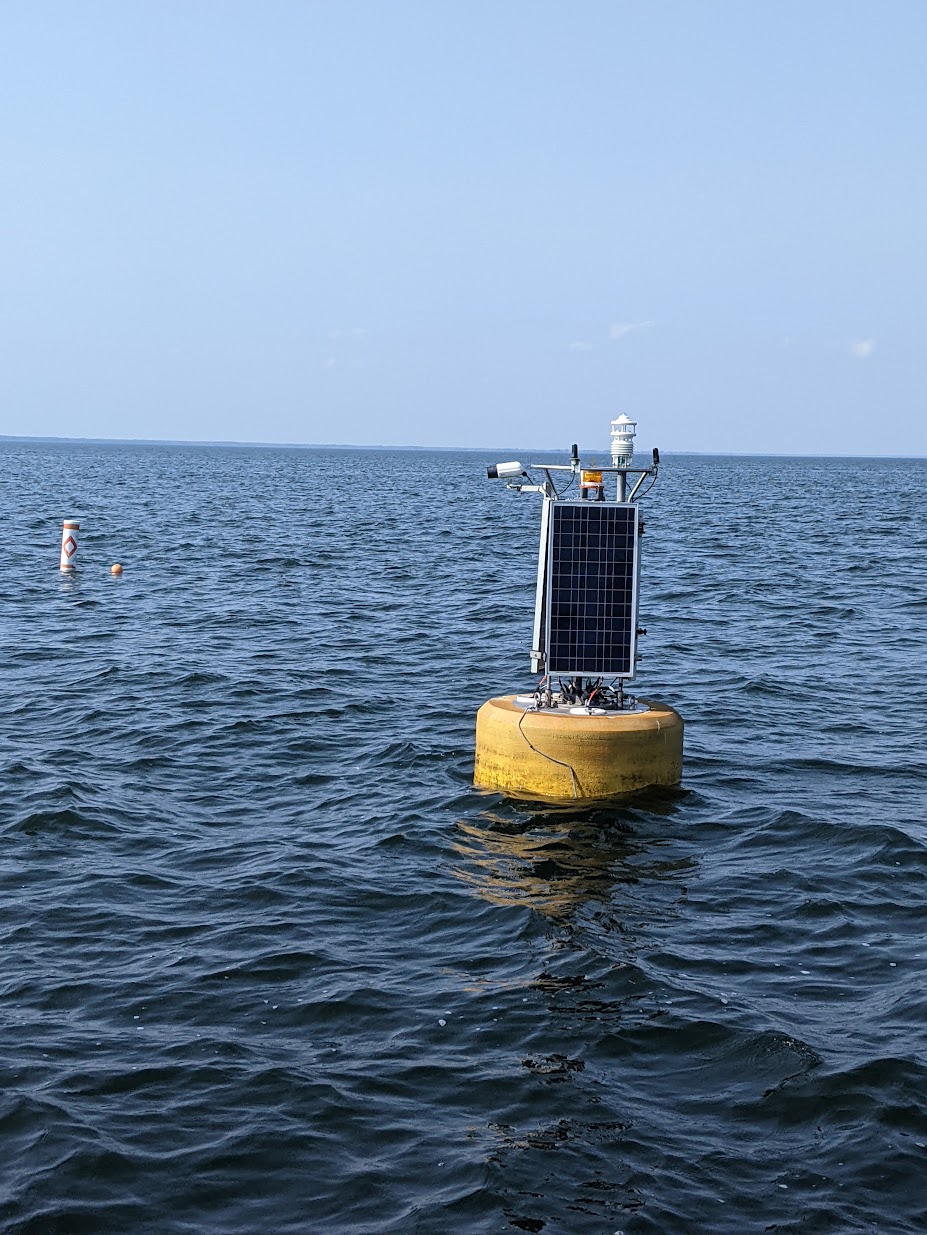
UW-Milwaukee School of Freshwater Sciences’s GB17 Buoy in Green Bay. Courtesy of J. Val Klump
It was either the third or fourth year we had been farming projects out to PIs that studied various aspects of things. In the last year, I decided we should think about how we monitor this system better. We started a monitoring network and it was modeled after the modeling framework that the National Science Foundation had put together years earlier. We had the experience to know how to do this and we had already purchased a buoy with that DARPA money – a big buoy we had out on Fox Point. We had the understanding how important data is and how hard it is to get, and nobody [else] was doing any continuous monitoring, except for the NDBC buoys in Lake Michigan.
We focused on the nearshore of Milwaukee, because it was logistically easy to get to. But we did put the one buoy out at Fox Point, which is 100 meters of water, and that was its own challenge.
How has GLOS supported your work?
J. Val Klump:
“The thing about GLOS, is the consistency of supporting the effort [and] understanding the importance of monitoring. It’s a hard thing to sell. It’s often the first thing that management agencies cut. When budgets are tight, they say, “Well, maybe we don’t need to sample Lake Winnebago this year,” or “maybe we don’t need to sample the lower Green Bay.”
GLOS has understood that that is not only important, but also essential. The key is keeping at it. The Great Lakes biologically are a very non-steady state; the inherent variability system is really high. If you want to pick out a long term, gradual trend like climate for example, you have to have staying power to see that. The changes are there, but unless you have enough data, you can’t separate that trend from the internal noise of the system. GLOS has also pioneered using continuous monitoring technologies. Sampling once a month or even once a week risks aliasing key dynamics that only show up if you monitor 24/7.“
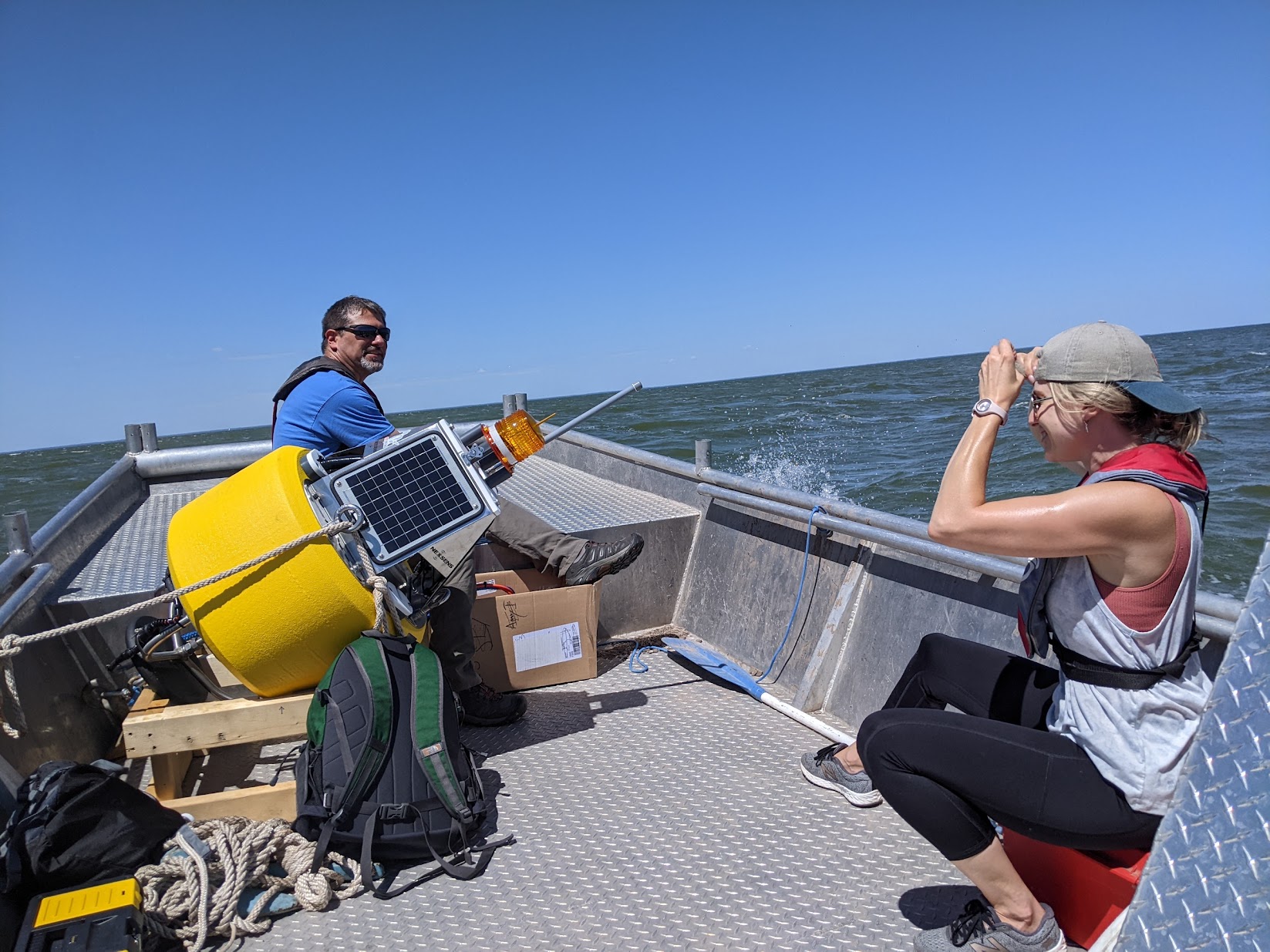
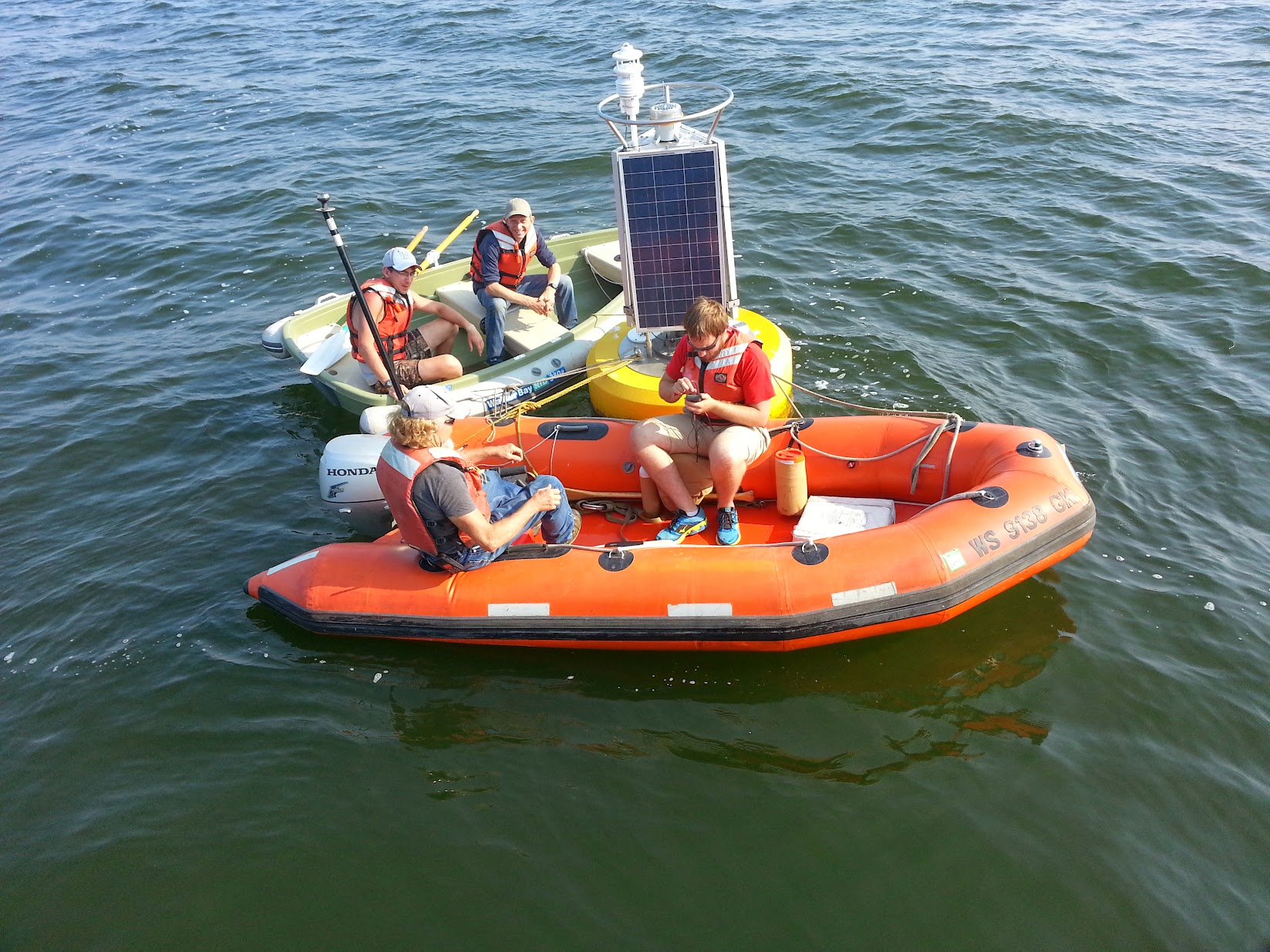
Michael Zorn, UW-Green Bay, and Jessie Grow, UW-Milwaukee, deploying a buoy in Green Bay. Courtesy of J. Val Klump
What was your main motivation for reaching superior maximus?
J. Val Klump:
“It was at the beginning of the National Undersea Research Program, NURP, which was part of NOAA. Dick Cooper, at the University of Connecticut, had a brother, Bill ‘Wild Bill’ Cooper, at Michigan State. Those two brothers got together and said “Hey, wouldn’t it be cool if we brought the manned submersible into the Great Lakes?” Larry Boyer, who was a scientist and colleague at the Center for Great Lakes Studies and in the geology department, had seen an article about the manned submersible coming into the Great Lakes. He talked me into it and we submitted a proposal.
The first set of dives were in Lake Superior in 1985, and we went up there to do comparisons with the other lakes, asking questions. For me it was the sedimentary biogeochemistry and how efficient is carbon burial and how nutrients are recycled. Of course, if you’re going to go, go to the deepest spot. Right? That’s where the mud’s going to be.
We pulled up and anchored one night in Batchawana Bay and at night they would shine the lights on this submersible, because it looks so cool. Well, there was a chironomid hatch. Every square centimeter of that submersible had a bug on it. Of course, there are no significant marine insects in the ocean; I think there’s one or two – so this was entirely new for these guys from Harbor Branch Oceanographic Institute. In the morning the chief bosun had the fire hose out and was blast washing everything, sending our science gear flying all over.
After that, they didn’t turn the lights on.“
Is there a particular project, partnership, or product of which you are particularly proud?
J. Val Klump:
“I’ve been very fortunate – very lucky. It’s hard to imagine how lucky I’ve been. The key thing has been the people I’ve been able to work with: the students and my colleagues and the crew. It has been a huge group effort. I’m also proud of what we have been able to accomplish at UW-Milwaukee in establishing the first stand-alone School of Freshwater Science in the country. It’s a testament to how important the Great Lakes are to our region, its health and prosperity.“
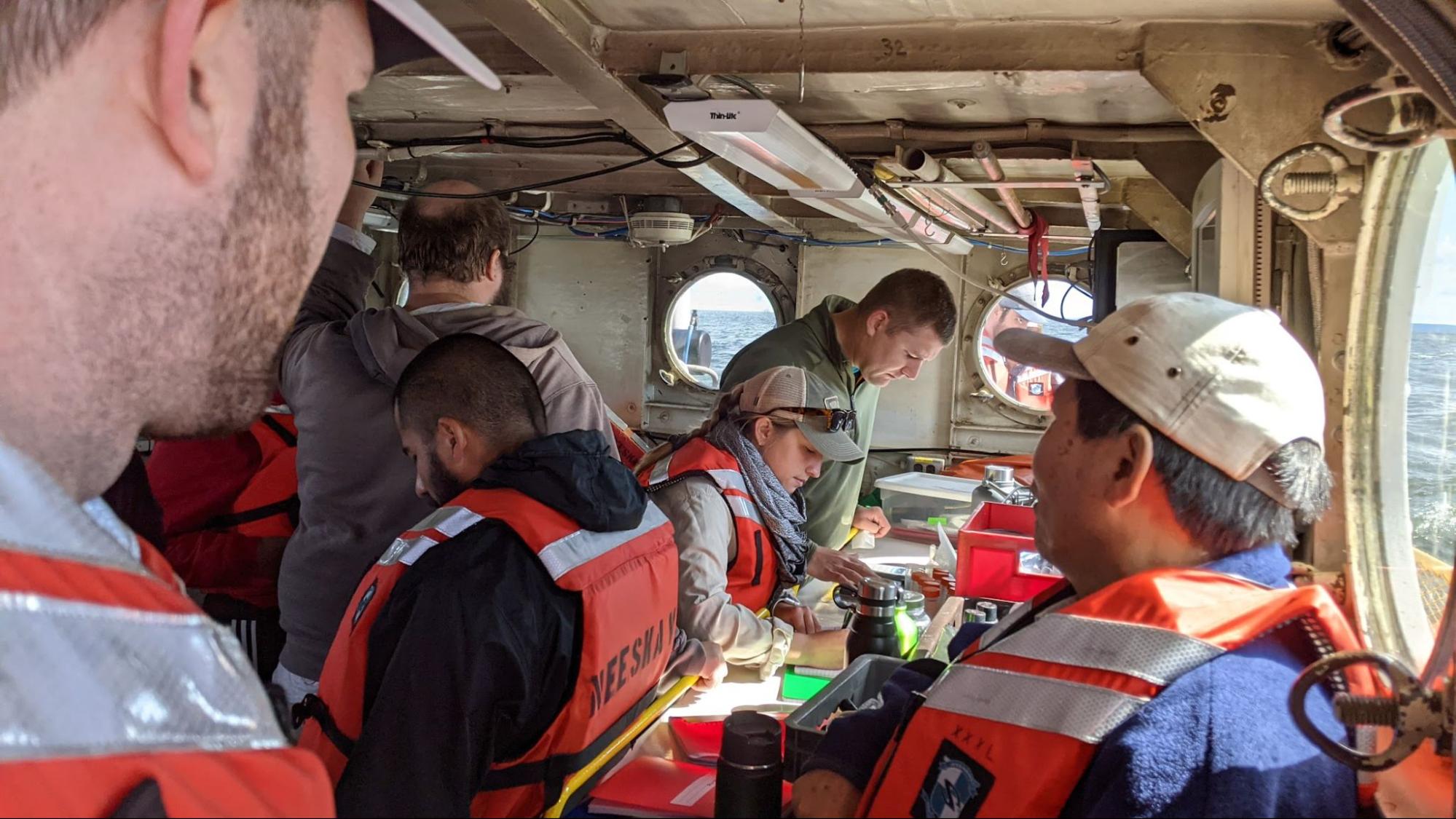
Above: UW-Milwaukee scientists, technicians, and collaborators gather inside the R/V Neeskay wet lab during a research cruise.
Right: UW-Milwaukee field crew tending to the Green Bay buoy in summer 2014.
Both courtesy of J. Val Klump